Research Areas

Transfer learning for high-dimensional data
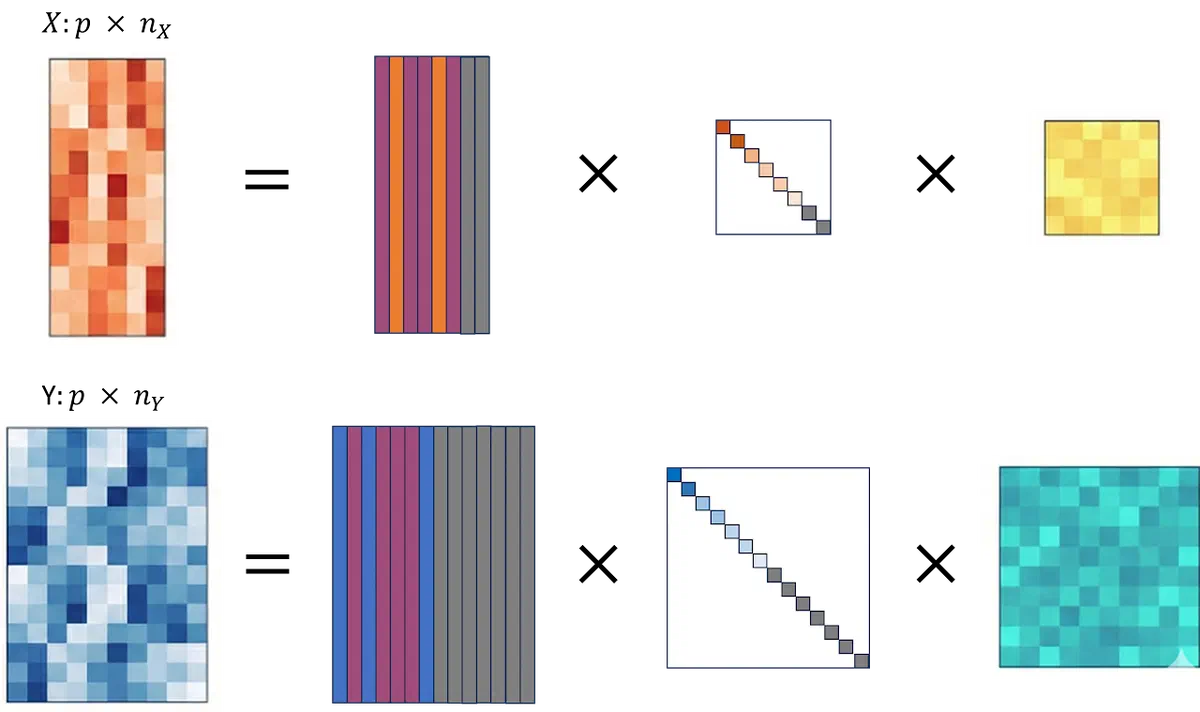
Target and source data matrices with their spectral decompositions, illustrating shared structure for transfer learning.
Modern data analysis often involves high-dimensional data where the dimensionality of the data is considerably high. Analysis of such high-dimensional data can be challenging in that many statistical models require a large sample size compared to dimensionality for accurate estimation and inference. However, along with target data of interest, we often may find an additional source dataset collected from another group with a large sample size. Our lab aims to develop methods which can improve the target data analysis results by leveraging such source data. For example, we have developed a transfer learning framework for high-dimensional covariance matrix estimation based on spectral similarity between target and source data. Through improvements in covariance estimation, we may expect enhancements in various downstream tasks such as PCA (principal component analysis), LDA (linear discriminant analysis), and network analysis.
View related publications
Compositional data analysis

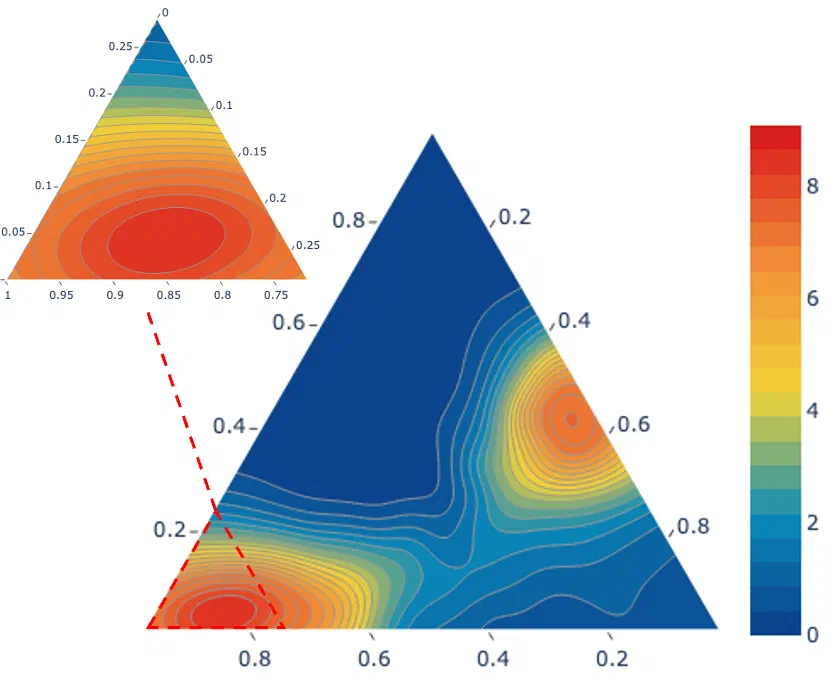
Density contours on a triangular simplex, with a magnified view near its boundary.
Compositional data consist of multivariate non-negative variables for which only relative information among components is meaningful, subject to a constant-sum constraint. Accordingly, compositional data are defined on a simplex rather than in a Euclidean space, which induces an inherent dependence structure among components. A common solution for this geometric constraint involves employing log-ratio transformations which map compositional data to a more tractable space. However, this approach encounters difficulties in the presence of zero components and may introduce distortions in the analysis results. Hence, our lab is working on developing methods to analyze compositional data with zeros without such limitations. For instance, we proposed a kernel density estimation method for compositional data with zeros which guarantees convergence to the true density. Also, we studied an interpretable dimension reduction technique and a mean estimation method for high-dimensional compositional data often encountered in microbiome research.
View related publications

Synthetic data for data privacy

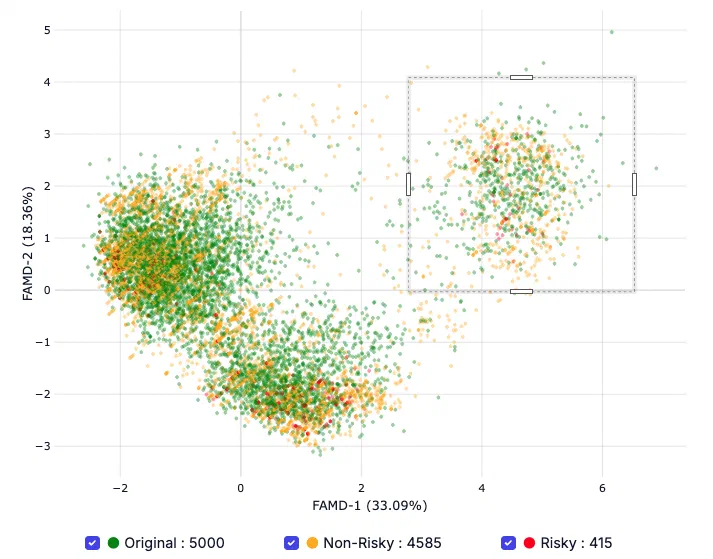
A scatter plot comparing original data with synthetic observations classified by disclosure risk.
Modern machine learning increasingly relies on access to high-quality datasets, yet many valuable datasets cannot be broadly shared as they contain privacy-sensitive information about individuals. As a result, the demand for privacy-preserving data sharing techniques is growing, and synthetic data has emerged as a practical solution. Our lab studies synthetic data generation methods across diverse data types. We develop methods that produce high-utility synthetic datasets by preserving statistical fidelity, including key distributions, dependencies, and higher-order structure, while ensuring domain validity through constraint-satisfying and internally consistent samples. We also aim to reduce privacy risks such as membership inference and attribute disclosure, thereby balancing utility and privacy.
View related publications